THE KIND OF MEN WHO CARRY A POCKET KNIFE

Less than 40 years have passed and I am astonished to see how the times have changed since my father bought this knife for me as just a small boy. I do still have it, which by today’s standards is an anomaly. I’ll leave the discussion of our throwaway culture for another time.
Yes, this pocket knife has witnessed many changes in our society. Technology, communication, transportation, and even education have transformed from the way it was just a generation ago. My pocket knife and I are neither quite certain if all the changes have been for the good. When I look across the landscape of America and note the differences, the greatest change I see is in the people themselves.
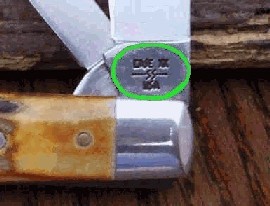
Growing up in rural Northeast Alabama in the foothills of the Appalachians, I was privileged to catch the tale end of what was an era marked by ruggedness and self-sufficiency. I grew up around men that will fix what was broken and take the time to do it right. My father was a Vietnam veteran and the product of growing up farming the hills of these same mountains where I was raised. He always carried a small pocket knife, much like the one pictured. He had an affinity for Case knives, but would carry the occasional “Old timer” or “Buck” or even “Schrade”. One thing was for sure, that he had one with him, wherever he was. You could also be pretty sure that his pocket knife would be so sharp that if you were to stare at it too long, your eyeballs would bleed. Now that’s pretty sharp…. The pocket knife was an important part of his life. Whether it was to slice a freshly picked apple, or to cut some twine, (coincidentally twine can patch most any broken farm implement until you can get home) he was always prepared. At Christmas time, my father always had his knife waiting to help open those pesky gifts that needed cutting open as only a father can do best.
My father was not the only man in my young life that I watched wield his trusty 3 bladed pocket knife as if it was a surgeon’s scalpel. My uncles, my friend’s dads, my bosses, they all carried pocket knives. I watched. I learned. These men have a lot of ingenuity, that is rare today. For my father and so many others of a generation gone by, a pocket knife was an essential tool for daily life. The men who carry pocket knives are hardworking, do-it-yourself types, who were raised to rely on themselves and be prepared in nearly every situation. I have seen a pocket knife start a tractor, remove a splinter, slice a watermelon, carve a toy, and open a can. They have been used to clean wild game, cut gum/tar out of hair, sharpen a pencil, cutting fishing bait, and teaching responsibility. The list goes on and on. The uses of the pocket knife are as varied and strong as the men who use them.
I adopted this tool at a very early age as one that would always be at my side. A pocket knife has always been a part of who I am. So much so that someone almost offended me when I would encounter a grown man who didn’t have one in his own pocket. I took it upon myself in my 20s to gift knives. Sometimes to random strangers, sometimes to close friends. The conversation would start by asking if I could borrow someone’s knife, knowing full well that I had 2 in my pocket. If the answer was a proud “why sure”, then I would gladly take the knife and inspect it for its level of wear as an indicator of how much work it had actually seen. Often paying a simple compliment as I return the knife. If the answer was that they didn’t have a knife to let me borrow, I would quickly reach into my pocket and deliver one to their hand, along with a reference to the fact that every man should carry a knife. To date, I have given out somewhere north of 300 knives.
So, who are the men who carry pocket knives today? They are typically utilitarian. They are the type of men who work hard for a living, fix what is broken, and stand fearlessly in the face of a world full of evil. To put it simply, they are the type of men that I feel this world needs more of.
If you find yourself in a tight spot and need some help, just ask the guy with the pocketknife. Although they are few are far between these days, chances are he can and will lend a hand.
reprinted from: The Natural South,Jackson Farmstead
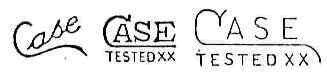
 The above stamps were the most common used by Case on knives that were manufactured in the years prior to 1920.
 You will find that most books date this stamp as being used from 1920 to 1940. I have found that many serious knife collectors disagree with this date range and say that it was actually used from 1919 to 1945. It has been my experience that collectors call knives with these stamps “Tested” or “Circle C” era knives.
 You will find that most books date this stamp as 1940 – 1964. I have found that many serious knife collectors say that it was actually used from 1945 – 1964. It has been my experience that collectors call knives with these stamps “XX” era knives.

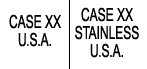
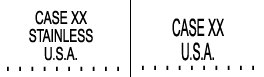 The stamps used from 1970-1979 are the same as those used between 1965-1969 except that dots were added below the U.S.A. 10 dots were added in 1970, and for every year thereafter, one dot was removed so that each year had a unique stamp. For clarification, note that ten dots appear on 1970 knives, nine dots appear in 1971 knives, eight on 1972 knives, and so on.
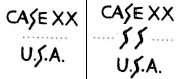 Throughout the 1980’s, Case used the same dating system as the 70’s. 1980 knives have 10 dots, and one is removed each year. Unlike 70’s knives however, the s’s are lightening shaped, and the dots are located between the Case XX, and the U.S.A.
 Beginning in 1990, Case replaced the dating system with a stamp that imprinted the actual date on the knife tang. This was not as popular with collectors, so Case changed back to the dot dating system in the middle of 1993.
  From the middle of 1993 to 1999, Case returned to the dot system that was used in the 70’s and 80’s. Case also returned to using a long tailed C on the word Case which resembled the older tang stamps. The dots started in 1993, and one was removed for every year until 2000. On some knives in this era, the S in U.S.A. is lightening shaped like those in the 80’s.
 In 2000, Case developed a dating system using an old style Case XX stamp along with a mix of dots and x’s both above the Case XX symbol and below. Case started with 5 x’s, and 5 dots in 2000. For each year thereafter, they removed one dot. When all of the dots were gone after 2005, the x’s were removed one by one until 2010.
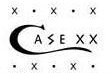 For the year 2010, Case switched to a tang stamp dating system similar to the prior decade (2000 – 2009). The 2010 stamp started with 3 xs, 2 dots on top & 2 xs 3 dots on bottom. One dot removed for each year up to and including 2015. For each year thereafter, one x removed each year. 2019 knives will have a single x.


 Ken Am Unlimited